How to Choose a Dubai Buggy for Desert Riding
@eveningdesertsafaridubaifocus
Understanding Your Needs
Choosing a buggy for Dubai's desert terrain is not the same as picking a vehicle for tarmac or groomed trails. The dunes here vary from soft, shifting sand to hard-packed ridges, and the vehicle you pick needs to match both the environment and your experience level. Before you look at any machine, think about what kind of riding you plan to do. Are you after a short thrill on a designated track, or do you want a longer outing that covers several kilometres of open desert? The answer will shape every other decision you make.
Desert dune buggy designs differ mainly in engine power, suspension travel, and seating configuration. A basic recreational model often has a smaller engine and simpler suspension, which suits someone who wants a gentle introduction to off-road driving. A performance-oriented buggy, by contrast, packs more horsepower and a sturdier frame, but it also demands more from the driver. Knowing where you fall on that spectrum is the first step.
Check the Engine and Power
The engine is the heart of any off-road vehicle. For Dubai's sand, you generally want enough power to climb a dune without stalling, but not so much that the vehicle becomes hard to control. Smaller buggies often use engines in the range of 800cc to 1000cc, which provide a relaxed pace on moderate slopes. Larger machines can go up to 1200cc or more, offering higher top speeds and better torque for steep ascents.
Pay attention to the type of cooling system as well. Air-cooled engines are simpler and lighter, but they can overheat during prolonged runs in the summer heat. Liquid-cooled engines handle heat better, making them a safer bet for longer rides or for anyone who plans to drive hard. Ask about the engine's service history and whether the cooling system has been maintained. A well-kept engine is far more reliable than one that has been neglected, regardless of its size.
Evaluate the Suspension System
Sand dunes are uneven, with sharp dips and sudden rises. A good suspension system keeps the wheels in contact with the ground and prevents the chassis from bottoming out. Most desert buggies use either independent suspension or a solid-axle setup. Independent suspension allows each wheel to move separately, which gives better traction on rough terrain. Solid axles are simpler and can be more durable, but they tend to transmit more shock to the frame and the driver.
Look for adjustable suspension if you can. Being able to tweak the damping or the spring preload lets you tune the ride for your weight and for the specific dune conditions you expect to encounter. Test the vehicle on a short track if possible, or at least sit in it and press down on each corner to feel how much movement there is. A suspension that feels too soft may bottom out easily; one that feels too hard will be uncomfortable and may reduce grip.
Consider the Seating and Safety Features
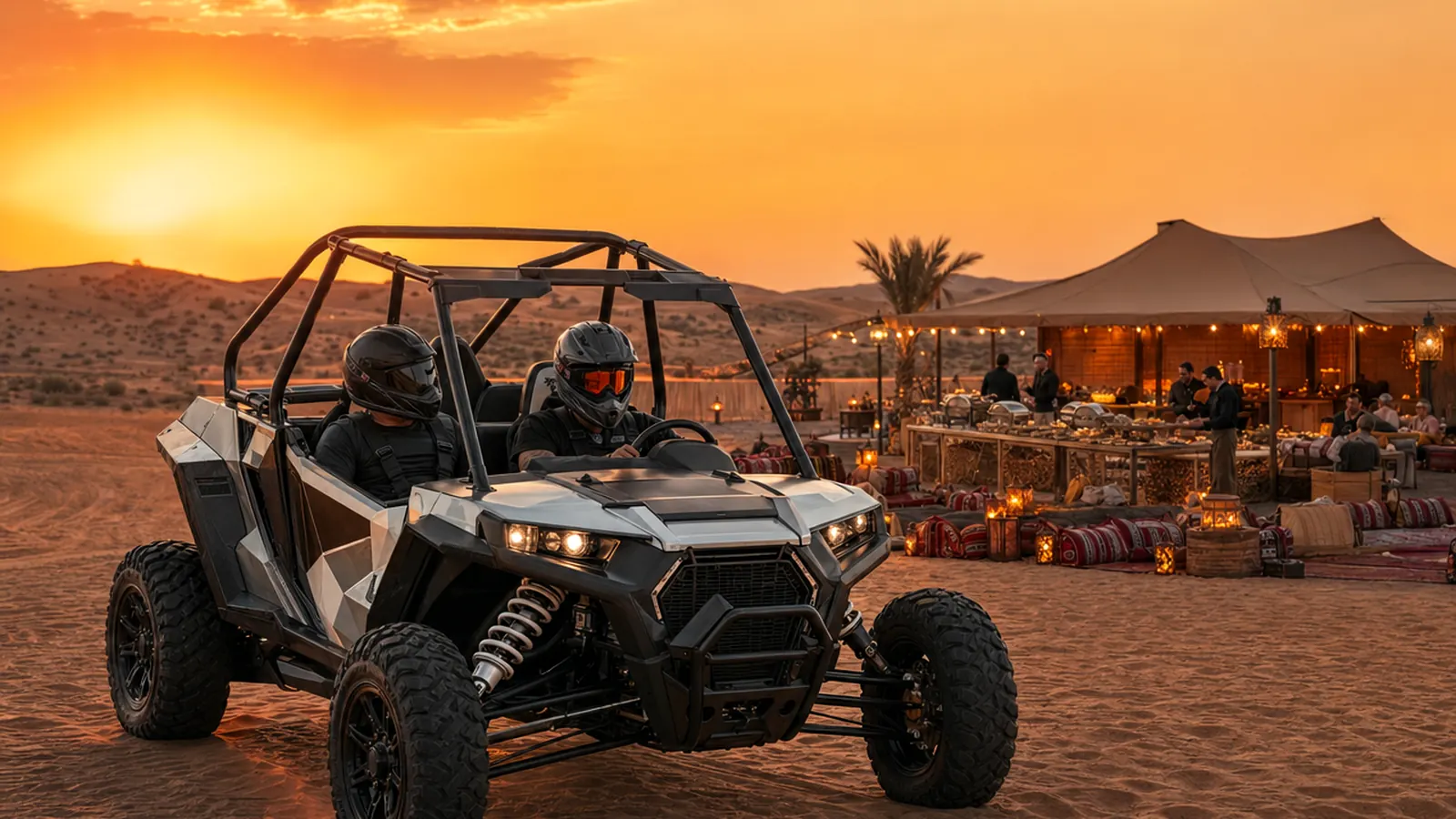
Buggies come in two-seat, four-seat, and even single-seat configurations. Two-seat models are more manoeuvrable and lighter, which helps in soft sand. Four-seat buggies are heavier and wider, but they let you share the experience with more people. Think about who will ride with you and whether you need space for equipment such as cameras, water, or spare parts.
Safety features matter just as much as comfort. A proper roll cage, harness-style seat belts, and a helmet are non-negotiable. Some buggies also include a kill switch that stops the engine if the driver is thrown from the seat. Check that all restraints are in good condition and that the harness buckles securely. If you are renting, ask about the condition of the safety gear and whether it is replaced regularly. A safety briefing before you set off is a good sign that the operator takes these matters seriously.
Look at the Tyres and Wheels
Sand tyres are different from the tyres you see on a road car or even on a general off-road vehicle. They usually have a wide footprint and a tread pattern designed to spread the vehicle's weight and prevent digging in. Some buggies use bead-lock rims that keep the tyre seated on the rim at low pressures, which lets you deflate the tyres for extra flotation on soft sand.
Dune Buggy Dubai and Quad Bike Rental | Desert Safari , KTM Dirt Bike , CanAm Rental is also on YouTube.
Check the tyre condition before you commit. Look for cuts, bulges, or uneven wear. Worn tyres will struggle to grip, and they increase the risk of getting stuck or losing control. Ask what pressure the tyres are set to and whether you can adjust it for the conditions you will ride in. Proper tyre pressure is a simple adjustment that makes a big difference in how the buggy handles.
Think About the Driving Licence Requirement
In Dubai, driving a buggy on public roads or in certain desert areas may require a valid driving licence. The rules vary depending on whether you are on a licensed track or in an open desert area. Some rental operators ask for a standard UAE driving licence, while others accept an international driving permit. If you do not hold a licence, you may still be able to drive on private land or within a dedicated off-road park, but you should check the specific policy of the operator you choose. It is worth confirming with whichever business you choose what documentation they need before you book.
Rent or Buy?
For most visitors, renting a buggy is the practical choice. Rental fleets are maintained by operators who specialise in desert vehicles, so the machines are usually set up for the local terrain. Renting also lets you try different models before you decide what you like. If you plan to ride frequently, buying your own buggy might make sense, but you then have to handle storage, transport, maintenance, and insurance. One local option is Dune Buggy Dubai and Quad Bike Rental | Desert Safari, KTM Dirt Bike, CanAm Rental.
Test Before You Commit
Whenever possible, spend time in the buggy before you pay or sign a long-term agreement. Sit in the driver's seat and check that the pedals and steering wheel are within comfortable reach. If you are renting, ask for a short familiarisation drive on flat ground before you head into the dunes. This gives you a feel for the controls and lets you spot any issues with the machine. A reputable operator will not rush you through this process.
Listen to the engine when it is running. A smooth, steady sound is a good sign. Any knocking, whining, or irregular idling suggests a problem that could leave you stranded. Also check the brakes. They should feel firm and responsive, not spongy. If anything feels off, ask for a different machine or walk away.
Plan for the Conditions
Dubai's desert is beautiful but demanding. Heat, sand, and direct sunlight all take a toll on both the vehicle and the driver. Dress in lightweight, long-sleeved clothing to protect against sun and sand. Bring plenty of water, and avoid riding during the hottest part of the day. A desert track can be challenging even in the best conditions, so go with a group or at least let someone know your route and expected return time.
When you search for a buggy dubai, you will find many options ranging from basic models to high-performance machines. The key is to match the vehicle to your skill level and to the kind of terrain you plan to tackle. A buggy that feels right on a short test drive may behave differently after an hour in deep sand, so trust your instincts and do not be afraid to ask questions.
The phrase "buggy dubai" appears in many rental listings, but the machine behind the name can vary widely. Take the time to inspect the buggy yourself, or ask someone knowledgeable to help you. A little effort upfront can save you from a breakdown in the middle of the desert and make your ride far more enjoyable.
Dune Buggy Dubai and Quad Bike Rental | Desert Safari, KTM Dirt Bike, CanAm Rental is located at 28 Academic City - Rd Arab Tec Building - Block A Office AN114 - ند حصه - واحة دبي للسيليكون - دبي - United Arab Emirates.